


What Korea stands to gain — and lose — from U.S.-Saudi nuclear deal

NEWS ANALYSIS
The latest U.S.-Saudi Arabia agreement could hand Korea’s nuclear reactor contracts straight to Washington — but in the process, it may also highlight how essential Korean partners have become to America’s own nuclear supply chain.
Washington may now have a higher chance of landing top-level deals, but not the execution, say experts. The United States still lacks the stand-alone capacity to deliver, leaving it little choice but to lean on its Korean partners for construction and parts.
The U.S. Department of Energy on July 22 announced a peaceful nuclear cooperation agreement with Saudi Arabia, commonly known as a 123 agreement, alongside an accompanying bilateral safeguards accord.
Though the full terms have not been made public, the department said the agreement would give “American firms expanded access to Saudi Arabia’s nuclear program” — a shift several foreign outlets have interpreted as positioning the United States to win nuclear project deals in Saudi Arabia.
Westinghouse, the Pennsylvania-based industrial giant, is widely expected to be the chief beneficiary, with its large AP1000 reactors seen as the most likely model for the project.
Washington’s reversal
Should Washington secure the contract with Riyadh, experts contend it would effectively contradict an earlier arrangement between Washington and Seoul. Korea, however, has little recourse in the matter, and stands only to lose access to the Saudi market.
Korea Electric Power Corporation (Kepco) and Korea Hydro & Nuclear Power (KHNP) had spent years in a dispute with Westinghouse over intellectual property — namely, whether Korea’s APR1400 reactor design was derived from Westinghouse’s AP1000 technology.
That dispute was resolved in January 2025 through an agreement dividing royalties and export territories: Westinghouse secured exclusive rights across most of Europe, excluding the Czech Republic as well as Japan, Ukraine and North America, while Korea is reported to retain the right to independently export to the Czech Republic, the Middle East, Southeast Asia, Africa and South America.
“If the AP1000 is selected for the Saudi project, Korea would have every right to feel cheated,” said a senior source in the nuclear industry, who spoke on condition of anonymity.
“But the relationship between Westinghouse and Korean firms remains fundamentally unequal; If Washington decides to proceed, Korea has little recourse and simply loses Saudi [Arabia] as a client.”
U.S. President Donald Trump, left, greets Crown Prince and Prime Minister of the Kingdom of Saudi Arabia Mohammed bin Salman at the White House in Washington on Nov. 18, 2025.
AFP/YONHAP
Under the agreement, Korea is obligated to ink deals worth some $650 million in goods and services from Westinghouse per reactor exported, along with $175 million in technology licensing fees per unit.
James Danly, the U.S. deputy secretary of energy, reportedly urged Seoul to use U.S. reactors rather than its own when bidding for the Saudi project during his meeting with senior Korean government officials in October of last year.
Viewing nuclear energy a principal alternative to reducing dependence on oil, Saudi Arabia announced plans to build 16 nuclear reactors by 2030.
KHNP in 2009 clinched a roughly 22.6 trillion won ($16 billion) contract to build four APR1400 units in Barakah, United Arab Emirates (UAE).
Why Washington still needs Seoul
But even if the United States secures the Saudi contract, it lacks its own capacity to execute the project alone, experts say, leaving Korea as effectively its only viable partner, absent turning to Russia or China.
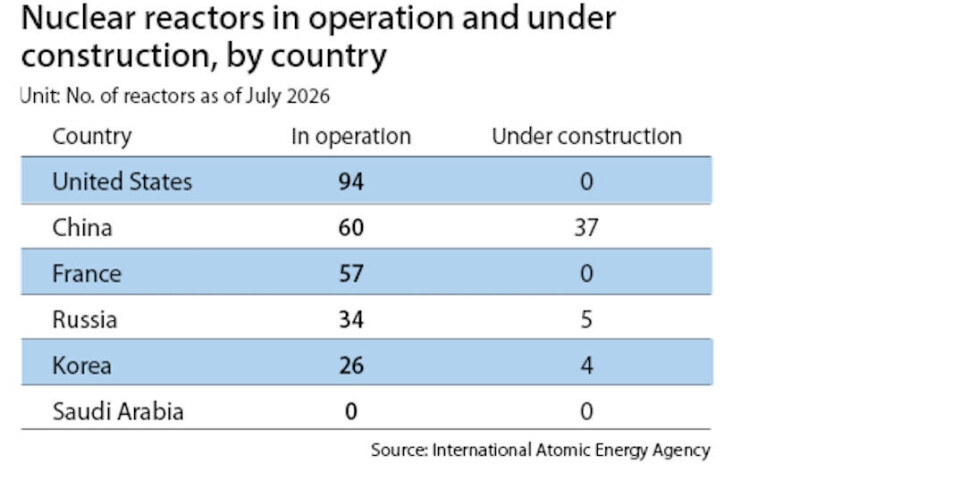
Russia and China currently dominate global reactor exports; China operates 60 reactors and is building 37 more, while Russia operates 34 and had five under construction as of July, according to the International Atomic Energy Agency. However, diplomatic considerations and reactor-design incompatibilities are expected to rule out both as partners for a U.S.-led Saudi project.
France, which operates 57 reactors, is the next-most-experienced alternate partner, but its construction costs run higher than Korea’s and its delivery record is considered weaker.
The cost for per-kilowatt construction for Korean companies stood at $3,571, compared to $4,174 for China, $5,833 for the United States, $6,250 for Russia and $7,931 for France, according to data from Korea’s Industry Ministry in 2024.
“Korea remains the only newcomer to the export market that completed all four Barakah nuclear reactors on time and on budget — effectively the only contractor in the world with that track record,” said Cho Hong-chong, an economics professor at Dankook University and chairman of the Korean Resource Economics Association.
“If the United States wants to rebuild the AP1000 supply chain around Saudi, Korea cannot be excluded,” Cho said. “Losing the client [Saudi Arabia] is unfortunate, but this remains an opening for the two countries to pursue joint projects elsewhere.”
Korea currently operates 26 reactors in Korea, with four more under construction. Beyond the UAE project, it secured a second major overseas contract last year to build units 5 and 6 at the Dukovany plant in the Czech Republic, a deal that could pave the way for additional units at the Temelin plant.
Nuclear construction in the United States has been largely dormant since the industry’s near-total halt following the 1979 accident at Three Mile Island, when regulators effectively stopped licensing new plants for decades. The skilled trades, specialized forges and engineering expertise that once supported large-scale reactor building have atrophied through disuse and a wave of retirements, leaving America’s technical know-how in reactor design far ahead of its ability to actually build.
In fact, of the six AP1000 reactors operating worldwide today, four are in China. The two most recent U.S. units, Vogtle 3 and 4 in Georgia — the first large reactors to break ground domestically in 34 years in 2009 — took seven years longer than planned and cost nearly two-and-a-half times the original budget.
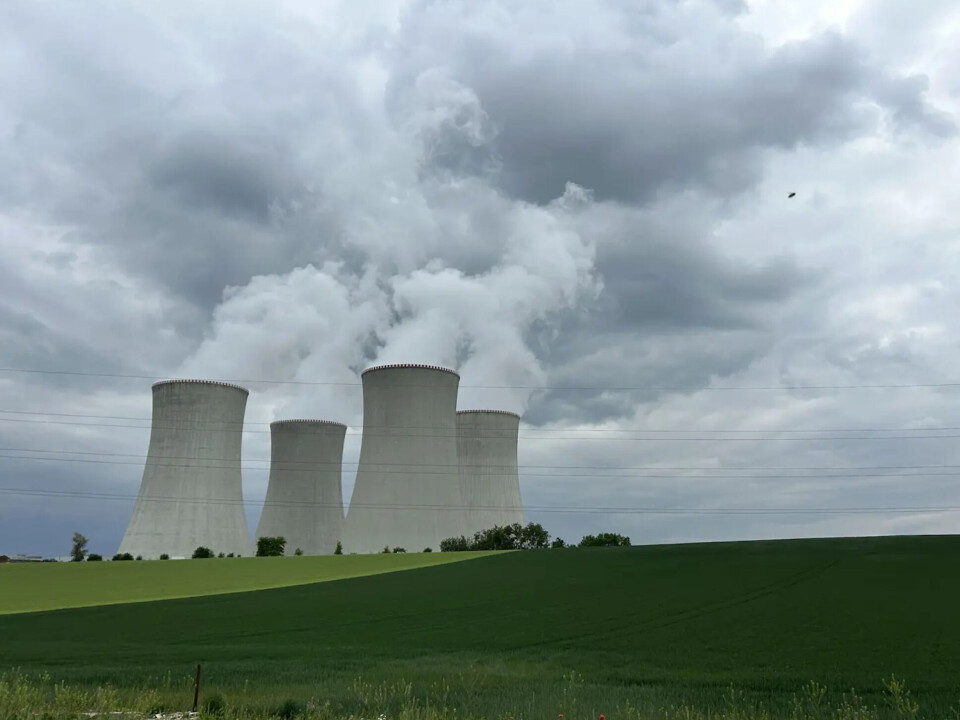
A view of the Dukovany nuclear power plant site in the Czech Republic
SARAH CHEA
Ties already in place
Even without a direct role as dealmaker, Korean firms — including Hyundai Engineering & Construction (E&C) and Doosan Enerbility — stand to benefit substantially given their existing ties to Westinghouse.
Hyundai E&C has an exclusive cooperative arrangement with Westinghouse, covering both large reactors and small modular units, and has secured priority negotiating rights for construction work on Westinghouse’s AP1000 projects.
The two have already inked a basic design contract for four AP1000 units planned for a combined energy-and-AI campus near Amarillo, Texas. In November of last year, they also signed a design contract for units 7 and 8 at Bulgaria’s Kozloduy plant — a roughly 20 trillion won project using the AP1000 design, with Hyundai E&C serving as the lead contractor.
The Hyundai-Westinghouse consortium was also selected for an early works agreement tied to a new reactor project led by the state utility Fortum in Finland, which is already undergoing feasibility studies. In Slovenia, they have advanced as a finalist to supply the JEK2 project, a new reactor planned by the state utility GEN Energy.
“What stands out is how many of these projects already involve strategic partnerships between United States and Korean builders — arrangements that go well beyond basic cooperation to include equity stakes, exclusive contracts and joint ventures,” said Kim Ki-ryong, a construction analyst at Mirae Asset Securities. “If American reactors are exported, Korean construction firms are structurally positioned to benefit directly.”
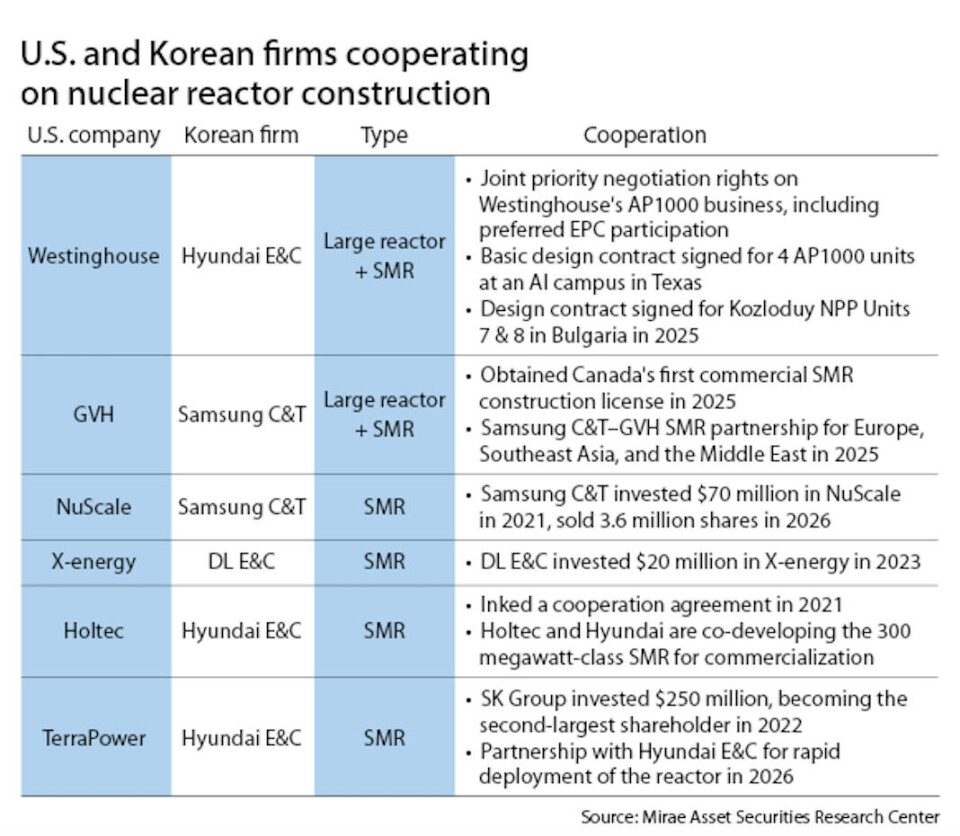
Hyundai E&C is also developing a 300-megawatt small modular reactor, the SMR-300, with Florida-based Holtec International, for commercialization.
Samsung C&T’s construction division has partnered with GE Vernova Hitachi Nuclear Energy, North Carolina-based nuclear company, to pursue projects in Europe, Southeast Asia and the Middle East.
Doosan Enerbility manufactures core components for Westinghouse’s AP1000 reactors including the reactor vessel and steam generators. After supplying five gas turbines to a U.S. Big Tech’s data center last year, Doosan secured an order for seven turbines with another U.S. tech giant in March.
Korea Electric Power Corporation Engineering & Construction, which handles overall architectural design, has emerged as a leading candidate to participate in Washington’s plan to break ground on at least 10 new AP1000 reactors by 2030 — most likely in integration work such as linking the reactor and steam turbine systems.
Meanwhile, some analysts suggest the possibility of an APR1400 export under the U.S.-Saudi framework cannot be ruled out, citing its proven construction speed, safety record and Westinghouse’s relatively cooperative stance.
“Saudi Arabia had shown interest in Korea’s APR1400 reactor designs and had been planning two 1,400-megawatt units — the area where Korea has sole experience,” said Chung Bum-jin, a nuclear engineering professor at Kyung Hee University, adding that the cooperation between Korea and Saudi Arabia never materialized due to “Washington’s continuous backing for Weshinghouse and Saudi Arabia’s desire for uranium enrichment rights.”
“There’s still a possibility,” he added, “that the APR1400 could be selected for export and Korea could have to give additional royalties to Westinghouse.”


