




Saudi merchandise exports rise 3.9% as trade surplus surges 328.8%

RIYADH — Saudi Arabia’s merchandise exports increased 3.9 percent in May 2026 compared with the same month last year, driven by a 19.5 percent increase in oil exports, according to the General Authority for Statistics (GASTAT).
The report showed that the merchandise trade surplus also surged 328.8 percent year-on-year.
Non-oil exports, including re-exports, declined 26.1 percent compared with May 2025, while national non-oil exports, excluding re-exports, fell 27.3 percent.
Re-exported goods also decreased by 24.4 percent, driven by a 32.4 percent decline in machinery, electrical equipment and parts, which accounted for 46.2 percent of total re-exports.
GASTAT’s figure showing the Kingdom’s non-oil exports and imports (May 2025-May 2026).
The ratio of non-oil exports, including re-exports, to imports declined to 33.8 percent from 36.8 percent in May 2025, driven by a 26.1 percent decline in non-oil exports alongside a 19.5 percent decrease in imports.
Machinery, electrical equipment and parts remained Saudi Arabia’s largest non-oil export category, accounting for 22.0 percent of total non-oil exports despite declining 31.6 percent compared with a year earlier. Plastics, rubber and their articles ranked second, representing 17.6 percent of non-oil exports after falling 28.2 percent.
Meanwhile oil exports accounted for 75.6 percent of total merchandise exports in May 2026, up from 65.7 percent a year earlier and merchandise imports fell 19.5 percent year-on-year.
On the import side, machinery, electrical equipment and parts accounted for 26.4 percent of total imports despite declining 28.0 percent, while mineral products represented 11.9 percent of imports after increasing 65.7 percent year-on-year.
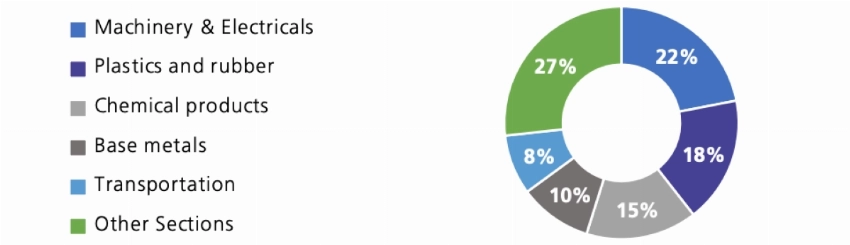
GASTAT’s figure showing the Kingdom’s most important non-oil goods imports (May 2026).
As for tardinf paretners, China remained Saudi Arabia’s largest merchandise trading partner in May, receiving 12.3 percent of the Kingdom’s exports and supplying 22.0 percent of its imports.
South Korea and the United Arab Emirates followed as the second and third largest export destinations, while the United States and Egypt ranked second and third among import sources.
For ports, Jeddah Islamic Sea Port remained the Kingdom’s busiest gateway for merchandise imports, handling 35.7 percent of total imports, while the top five customs ports processed a combined 73.8 percent of all imports.
The port also led non-oil exports, accounting for 24.4 percent of the total, with the five largest export ports together handling 65.2 percent of Saudi Arabia’s total non-oil merchandise exports.


